

By Stephen S. Luther, MD
Fueling the Human Engine: The Science of Energy, Performance, and Metabolic Health
If you have ever wondered whether carbs or fat are better for your body, you are asking exactly the right question. Most people spend years eating based on habit or outdated advice, never fully understanding how their body actually produces energy. Science is more nuanced than any fad diet suggests.
This article breaks down how carbohydrates and fats each function as fuel, when each is most effective, and why building metabolic flexibility may be the most important thing you can do for your long-term health and performance.
What Happens to Your Body When You Eat Too Many Carbs?
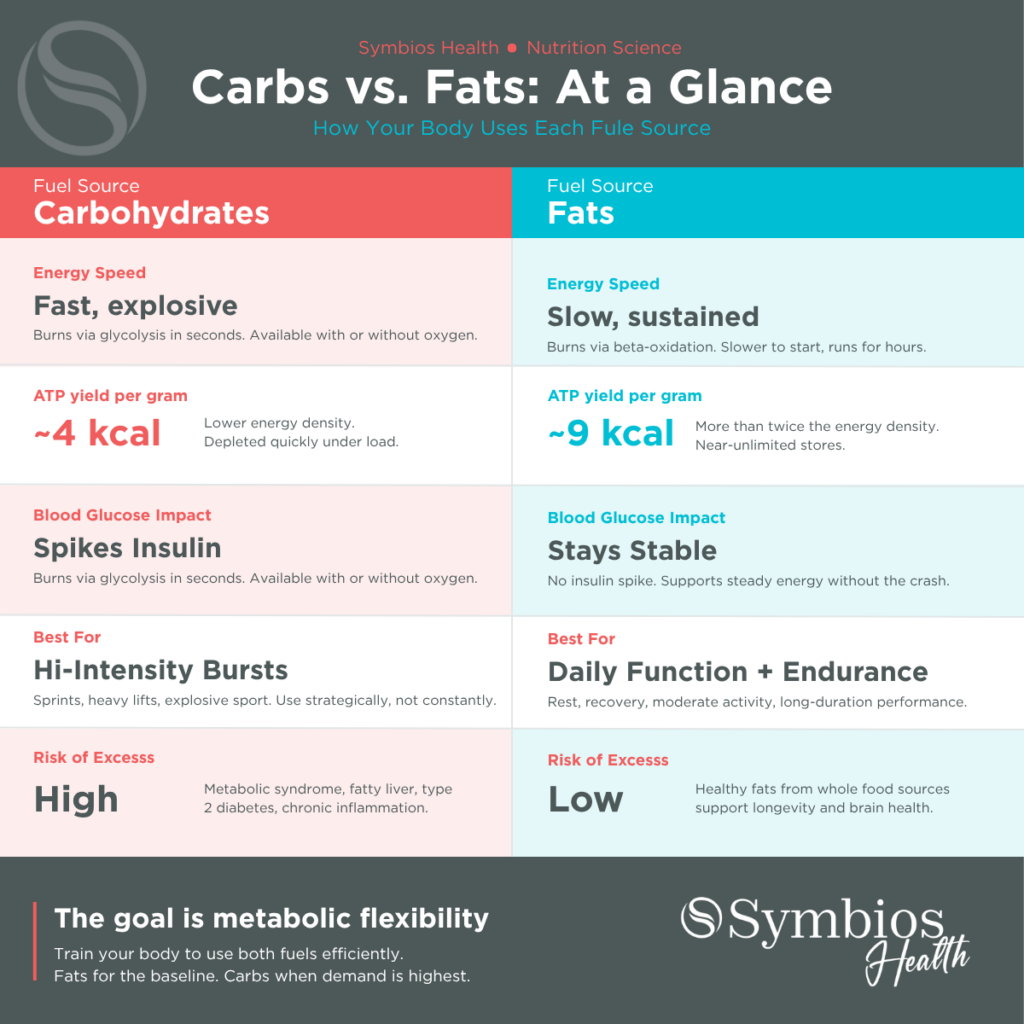
Carbohydrates hit your system fast. When you eat pasta, bread, or sugary snacks, your body breaks them down into glucose, which floods the bloodstream for immediate energy. This is useful for rapid-fire activities because glucose is metabolized quickly via glycolysis, providing ATP (the cell’s energy currency) rapidly. During intense efforts, carbs can supply nearly all the fuel your muscles need, both aerobically and anaerobically, for all-out sprints.
But that speed comes at a cost. High-carb intake spikes blood glucose, triggering a surge in insulin to shuttle sugar into cells. Over time, if you consistently consume refined carbs, your body can develop insulin resistance. Cells stop responding efficiently, leading to chronically elevated glucose. This sets the stage for type 2 diabetes, where the pancreas tires from overproducing insulin, or non-alcoholic fatty liver disease from excess glucose converting to fat storage. Even in healthy individuals, over-relying on carbs promotes inflammation and oxidative stress, accelerating wear on your internal systems.
Fatigue is another signal worth paying attention to. That deep exhaustion during a workout is often your brain’s alarm when glucose dips too low. The muscle-brain axis plays a central role: muscles signal the brain about energy status, and if glucose runs low, neurons fire off fatigue signals to conserve resources. This is evolution’s protective mechanism.
Why Do Fats Provide More Sustained Energy Than Carbs?
Dietary fats from high-quality animal sources like beef, lamb, pasture-raised poultry, whole eggs, and fatty fish, as well as from extra-virgin olive oil, avocados, nuts, seeds, and olives, break down into fatty acids. Your body oxidizes these through beta-oxidation for energy. This process is slower to start but yields a larger payoff: fats provide more ATP per molecule than carbs and tap into virtually unlimited stores, even in lean athletes. Your body fat reserves could theoretically power back-to-back marathons without refueling.
The real advantage becomes clear when carbs are low. Your liver ramps up ketone production from fats. These ketones supply up to 70–75% of the brain’s energy needs during low-glucose states. Unlike glucose, ketones burn cleanly, producing less oxidative stress and boosting neuronal efficiency. They cross the blood-brain barrier effortlessly, keeping your mental function steady when glucose falters. The liver also produces fresh glucose through gluconeogenesis, covering the brain’s minimal needs.
The real advantage becomes clear when carbs are low. Your liver ramps up ketone production from fats. These ketones supply up to 70–75% of the brain’s energy needs during low-glucose states. Unlike glucose, ketones burn cleanly, producing less oxidative stress and boosting neuronal efficiency. They cross the blood-brain barrier effortlessly, keeping your mental function steady when glucose falters. The liver also produces fresh glucose through gluconeogenesis, covering the brain’s minimal needs.
Why is fat often the better choice for sustained performance? No wild blood sugar swings, no insulin spikes. For everyday activities or moderate exercise, fats keep you going without the crash, preserving muscle glycogen for when you truly need it. This is the foundation of metabolic flexibility, a hallmark of resilient physiology.

Do Fat or Carbs Perform Better for Athletes?
Traditional sports nutrition has long positioned carbohydrates as essential for performance, particularly during very high-intensity efforts, and that reputation is not without merit. During short, explosive work where glycolytic metabolism is dominant, carbohydrate availability supports rapid ATP production.
However, emerging evidence suggests that carbohydrate’s primary performance benefit is less about directly fueling muscle contraction and more about preserving blood glucose levels and sustaining central nervous system function. In many cases, maintaining stable glucose protects cognitive output, motor drive, and coordination during demanding efforts.
During prolonged exercise, fat oxidation becomes increasingly dominant, especially in metabolically adapted athletes. In individuals well adapted to lower-carbohydrate or ketogenic strategies, rates of fat oxidation remain high even at intensities traditionally thought to require substantial carbohydrate reliance.
The classic “crossover point,” where carbohydrate utilization overtakes fat at moderate-to-high intensities, is not fixed. It shifts with training status, mitochondrial density, hormonal signaling, and dietary pattern. With proper adaptation, athletes can sustain higher intensities while drawing more from fat stores, preserving glycogen, reducing the need for frequent carbohydrate intake, and lowering the risk of exercise-induced hypoglycemia.
Metabolic flexibility, the ability to transition seamlessly between fat and carbohydrate depending on demand, is the goal. Overreliance on constant carbohydrate fueling blunts this adaptability, conditioning the body to depend on frequent glucose replenishment. Rather than viewing carbohydrates as universally superior, context matters: carbohydrates are highly effective for specific high-intensity demands, but fat oxidation provides stable, long-duration energy and metabolic resilience.
Can the Human Body Thrive Without Carbohydrates?
The question isn’t whether the body can survive without carbohydrates. It can. The better question is whether it can truly thrive. The answer is nuanced, rooted in physiology, and dependent on context.
Contrary to popular belief, carbohydrates are not biologically essential. There is no dietary carbohydrate deficiency disease. The body has built-in systems to maintain blood glucose even without dietary carbs. Through gluconeogenesis, the liver produces glucose from amino acids, glycerol, and lactate to supply tissues that require it.
The body does not inherently perform better on fats without carbs in every situation. It performs best when fuel use matches demand and when insulin and glucose remain stable rather than chronically elevated. For many people in today’s high-sugar environment, shifting toward greater fat utilization can dramatically improve metabolic health. For athletes and high-output individuals, strategic carbohydrate use can enhance performance without sacrificing metabolic stability.
The goal is not choosing sides in a fuel debate. The goal is building a body capable of running efficiently on both, intelligently, strategically, and without metabolic dysfunction.

When Should Athletes Eat Carbs vs. Fats for Performance?
Sprinters and power athletes have traditionally been told that aggressive carbohydrate intake is non-negotiable, often in the range of 5–7 g/kg/day for moderate training loads, to rapidly replenish glycogen and preserve explosive output. Glycogen restoration matters, particularly when sessions are frequent and glycolytic demand is high. But the assumption that high daily carbohydrate intake is universally required for power performance deserves more nuance.
The most immediate performance-limiting factor in high-intensity work is not simply empty muscle glycogen. It is the ability to maintain central drive, coordination, and stable blood glucose under stress. Carbohydrate availability helps preserve blood glucose and protect central nervous system output, which sustains motor unit recruitment and perceived effort. In other words, carbohydrates often support performance by stabilizing the brain as much as by refueling the muscles.
Through hepatic glycogenolysis and gluconeogenesis, the liver continuously produces glucose from lactate, glycerol, and amino acids, helping to maintain blood glucose levels even when dietary carbohydrate is low. Muscle glycogen is also replenished not only from dietary carbohydrate but indirectly through lactate recycling and endogenous glucose production. This means total daily carbohydrate intake does not always need to be extreme to support recovery, especially when training volume is controlled and metabolic health is intact.
Emerging performance models suggest that strategic timing matters more than sheer quantity. Even relatively small, targeted carbohydrate doses (roughly 10–15 g/hr) right before, during, or immediately after intense sessions can stabilize blood glucose, protect central output, and assist glycogen repletion without chronically suppressing fat oxidation. This approach preserves metabolic flexibility, allowing the athlete to remain efficient at oxidizing fat during lower-intensity work while still accessing carbohydrate when rapid ATP turnover is highest.
For power athletes, the goal is not maximal carbohydrate intake at all times. It is precision: enough carbohydrate to protect neural output and replenish glycogen when truly needed, without creating constant dependency that blunts metabolic adaptability. If you play golf, tennis, or pickleball, sport-specific training programs that integrate fueling strategy with movement training produce far better results than nutrition adjustments alone.
What Does Long-Term Carbohydrate Overconsumption Do to Your Health?
Excessive carbohydrate intake promotes de novo lipogenesis in the liver, turning surplus glucose into fats that accumulate, fostering fatty liver and dyslipidemia. Over the years, this cascades into metabolic syndrome: high blood pressure, insulin resistance, and inflammation, heightening risks for heart disease and type 2 diabetes. If you are already seeing signs of this pattern, a personalized weight-loss program that addresses metabolism, nutrition, and movement together is a more effective path than diet changes alone.
The solution is moderation and quality. Opt for clean carbohydrate sources such as wild rice, black rice, quinoa, and steel-cut oats to blunt glucose spikes, and pair them with healthy fats for stability. Many packaged “whole grain” products, particularly cereals and breads, are often highly refined or contain added sugars and processed flours, removing most of their metabolic benefit. Choosing minimally processed, fiber-rich carbohydrate sources supports metabolic health, reduces neuronal stress, and preserves the muscle-brain connection for peak performance.
How to Build a Body That Runs on Both
Your body performs best when it has access to both fuel systems and the metabolic intelligence to use them at the right time. Fats provide the foundation: stable, long-lasting energy for daily function, recovery, and endurance. Carbohydrates serve a targeted role: protecting central nervous system output and restoring glycogen when demand is highest.
The goal is not to eliminate one and maximize the other. The goal is to train your metabolism to use both, building the kind of physiological resilience that holds up under stress, supports long-term health, and keeps performance consistent. Metabolic flexibility is not a trend. It is how the human body was designed to work.
Precision Fueling at Symbios Health
At Symbios Health, we believe optimal fueling is not a trend. It is a science-driven strategy tailored to the individual. At our integrated health campus on Hilton Head Island, South Carolina, and under the clinical oversight of Dr. Stephen S. Luther, our team begins with a comprehensive metabolic assessment that evaluates metabolism, blood biomarkers, nutrition, and movement patterns before making any recommendations.
Whether your goal is elite athletic performance, restoring metabolic health, longevity, or physical vitality, we design personalized nutrition and exercise prescriptions rooted in data, not guesswork. We bring together primary care, performance science, and regenerative medicine in one place, so your care is coordinated and your results are measurable.
Frequently Asked Questions
Is fat or carbs better for weight loss?
Neither is universally better. Weight loss depends on total caloric balance, hormonal health, and metabolic function. For most people, reducing refined carbohydrates and increasing healthy fat intake improves insulin sensitivity, making fat burning more efficient. Our Healthy Weight Loss program starts with a full metabolic assessment, so your plan is built on your biology, not guesswork.
What is metabolic flexibility?
Metabolic flexibility is your body’s ability to shift between burning fat and carbohydrates depending on availability and demand. A metabolically flexible person burns fat efficiently at rest and during moderate activity, then accesses carbohydrates during high-intensity efforts. It is one of the strongest markers of long-term metabolic health.
Should I go low-carb if I work out regularly?
It depends on your training intensity, goals, and current metabolic health. Many people benefit from reducing carbohydrate intake on rest or low-intensity days and from using targeted carbohydrate intake around high-intensity sessions. A physician-guided assessment of your glucose dynamics, body composition, and performance goals will give you a precise answer.
What are the signs of poor metabolic health?
Common signs include energy crashes after meals, difficulty losing weight, brain fog, poor sleep, and elevated fasting glucose or triglycerides. These are worth evaluating with a clinical team rather than addressing through diet alone.
How do I know if I am carbohydrate dependent?
If you feel fatigued, irritable, or mentally foggy when you skip meals or go more than a few hours without eating, your body may have lost its ability to efficiently access fat for fuel. This is a sign of reduced metabolic flexibility and is addressable with the right clinical guidance. A comprehensive metabolic assessment at SymbiosEdge evaluates exactly these patterns and gives your care team a clear starting point.

References
- Adeva-Andany, María M., et al. “Liver Glucose Metabolism in Humans.” Bioscience Reports, vol. 36, no. 6, 29 Nov. 2016.
- Bai, Nina. “Pilot Study Shows Ketogenic Diet Improves Severe Mental Illness.” Stanford Medicine News Center, Nov. 2022 / Apr. 2024.
- “Fat: The Most Misunderstood Fuel Source.” IRONMAN, 2025.
- Noakes, Timothy D, et al. “Carbohydrate Ingestion on Exercise Metabolism and Physical Performance.” Endocrine Reviews, Spring 2026, p. bnaf038.
- Spriet, Lawrence L. “New Insights into the Interaction of Carbohydrate and Fat Metabolism during Exercise.” Sports Medicine, vol. 44, no. S1, May 2014, pp. 87–96.
- Spritzler, Franziska. “How to Boost Your Brain Health with Low Carb and Ketogenic Diets.” Healthline, 4 Dec. 2020.